

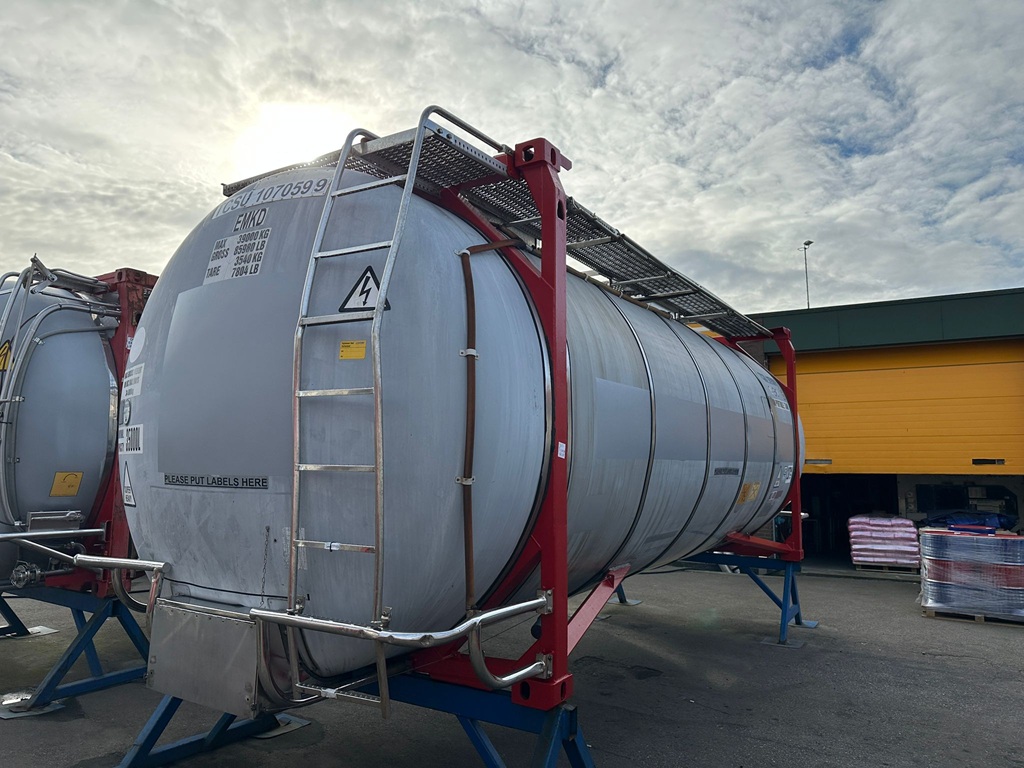
Container transport in the UK covers the movement of standard tank containers, SWAP tank containers, shipping containers and specialist intermodal equipment between ports, depots, production sites, storage facilities and customer locations. For liquid cargo, the transport plan must be built around the container type, cargo weight, tank capacity, certification, access conditions and legal requirements. A standard 20ft ISO tank container is commonly used for bulk liquid transport and usually has a capacity between 21,000 and 26,000 litres, depending on tank design and product density.
For higher-volume liquid logistics, 20ft SWAP tank containers are often preferred. A SWAP tank keeps the intermodal handling concept but is designed with a larger barrel, commonly offering around 30,000 to 35,000 litres of capacity, depending on specification. This makes it useful for certain food-grade and chemical liquid movements where payload, density and route rules allow.
At Tankcon, we plan container transport by checking tank type, gross weight, product classification, lifting points, site access, delivery method and documentation before arranging movement. Correct planning reduces delays, failed deliveries and safety risks.
Container Transport Services in the UK
Container transport services in the UK are used by manufacturers, chemical producers, food-grade liquid suppliers, logistics operators, terminals and industrial businesses that need containers moved safely between operational points. These services may include port collection, depot-to-site delivery, loaded tank movement, empty repositioning, export delivery, import delivery and site-to-site transfer.
For tank container work, the service is more detailed than standard box haulage. A 20ft standard ISO tank container may carry liquids in the 21,000–26,000 litre range, while a 20ft SWAP tank container may offer higher volume, often around 30,000 litres or more. The right choice depends on product density, legal payload, route, unloading method and customer site capability.
Transport planning should confirm the container number, tank type, gross weight, cargo status, product classification, collection reference, delivery address and access conditions. If the product is hazardous, ADR transport rules may apply.
At Tankcon, we focus on practical transport planning. Before the vehicle is arranged, we check whether the tank can be collected, moved, delivered and handled safely at both ends of the route.
Types of Containers Transported Across the UK
Different container types are transported across the UK, but liquid logistics often centres on 20ft standard tank containers and 20ft SWAP tank containers. A standard ISO tank container is built to ISO dimensions and is widely used for intermodal transport by road, rail and sea. It normally suits chemicals, food-grade liquids, oils, additives, solvents and other bulk liquid cargoes.
A SWAP tank container is designed with a larger tank barrel than a standard ISO tank. Many SWAP tanks are used in European road and intermodal liquid logistics because they can offer more volume, commonly around 30,000–35,000 litres, depending on tank design. This can make them useful where cargo density is lower and volume capacity matters.
Other containers transported in the UK include dry freight containers, refrigerated containers, open-top units, flat racks and storage containers. These are usually planned differently because they carry packaged or oversized cargo rather than bulk liquid.
At Tankcon, we match the transport plan to the container type. A SWAP tank, standard tank and dry container should not be treated as the same job.
Shipping Container Transport UK
Shipping container transport in the UK includes the movement of containers between ports, depots, warehouses, factories, farms, construction sites and storage yards. While dry shipping containers are often used for boxed or palletised goods, Tankcon’s transport focus also covers tank containers used for bulk liquid logistics.
A standard 20ft ISO tank container is designed for intermodal use and can move by road, rail and sea when certification and route requirements are met. It is typically used for liquids that need safe containment, valve protection and controlled handling. In many cases, the tank may carry between 21,000 and 26,000 litres, subject to product density and tank specification.
A 20ft SWAP tank container gives a different option for higher-volume liquid movements. Its larger barrel can provide more litre capacity than a standard ISO tank, but transport must still stay within road weight limits and axle load rules.
At Tankcon, we check whether the shipment needs standard ISO tank transport or SWAP tank transport before planning collection, delivery and site access.
ISO Tank Container Transport UK
ISO tank container transport in the UK is used for moving bulk liquids safely in certified tank equipment. A standard 20ft ISO tank container is one of the most common choices for chemical, food-grade and industrial liquid cargoes. Typical capacity is often between 21,000 and 26,000 litres, although exact capacity depends on the tank’s construction, insulation, baffles and cargo compatibility.
ISO tanks are designed for intermodal movement, meaning they can be transported by road, rail and sea when certification is valid. Key documents and markings may include CSC approval, tank test dates, pressure ratings, product approvals and dangerous goods information where relevant.
Loaded tank transport needs careful weight control. A tank filled with a dense product may reach legal payload limits before reaching full litre capacity. Product density, gross weight and axle loading must be checked before road movement.
At Tankcon, we treat ISO tank transport as a technical job. We review cargo type, tank specification, valve protection, documentation, site access and legal transport requirements before arranging the vehicle.
20ft and SWAP Tank Container Transport Services
20ft standard tank containers and 20ft SWAP tank containers are both used for bulk liquid transport, but they serve different operational needs. A standard 20ft ISO tank container follows ISO frame dimensions and is widely used for global intermodal transport. It is commonly selected for chemical, food-grade and industrial liquids, with typical capacities around 21,000–26,000 litres.
A 20ft SWAP tank container is built for higher-volume liquid movements, often with a larger tank barrel that extends beyond the standard ISO tank profile while remaining suitable for specialist intermodal handling. Depending on specification, SWAP tanks may offer around 30,000–35,000 litres of capacity. This can reduce the number of trips for lower-density liquids where payload rules allow.
The right option depends on cargo density, route, delivery site, loading method, unloading process and regulatory requirements. Higher capacity does not always mean better efficiency if the product is heavy or the site cannot handle the equipment.
At Tankcon, we compare standard ISO tank and SWAP tank options based on the actual cargo, not only the litre capacity.
Container Haulage Services in the UK
Container haulage services in the UK move standard tank containers, SWAP tank containers and other containerised equipment by road between ports, depots and customer sites. Tank container haulage requires suitable vehicles, trained planning and correct documentation, especially when cargo is loaded or classified as hazardous.
A standard 20ft ISO tank container can usually be carried on skeletal trailers designed for ISO equipment. A 20ft SWAP tank container may require more careful planning because the tank barrel is larger and the equipment specification can differ from a standard ISO unit. Vehicle suitability, twist-lock positioning, frame design and route restrictions should be confirmed before movement.
For loaded tanks, gross weight is a critical detail. The transport provider must know whether the tank is empty, cleaned, residue, loaded with non-hazardous liquid or loaded with dangerous goods. ADR requirements may apply depending on the product.
At Tankcon, we arrange haulage around real operating details: tank type, weight, product, collection reference, delivery access and site handling. Correct information prevents failed collections, delays and unsafe movements.
Container Collection and Delivery Across the UK
Container collection and delivery across the UK can involve ports, tank depots, chemical plants, food production facilities, industrial sites, storage locations and customer premises. For tank containers, the job starts before the lorry arrives. The collection reference, tank number, cargo status, gross weight, release details and destination must be checked.
A 20ft standard tank container may be collected from a port or depot for delivery to a filling site, cleaning station, repair facility or customer location. A 20ft SWAP tank container may be used where larger volume is needed, but delivery planning must account for site access, lifting capability and the tank’s exact specification.
Delivery conditions matter. The site should have suitable road access, level ground, safe working space and any required unloading equipment. If the tank will be lifted from the trailer, equipment capacity and lifting method must be confirmed. If it will remain on chassis for loading or discharge, waiting time should be planned.
At Tankcon, we check both collection and delivery points before confirming transport. A successful movement needs both ends of the job to be ready.
Door-to-Door Container Transport Services
Door-to-door container transport services in the UK cover the full movement from collection point to delivery point. For tank containers, this may include depot collection, port collection, delivery to a filling site, movement to a customer facility, return to depot, cleaning station delivery or export positioning.
A door-to-door movement can involve either a 20ft standard ISO tank container or a 20ft SWAP tank container. The standard ISO tank is widely used for international liquid logistics, while the SWAP tank can provide larger liquid capacity where the cargo and route are suitable. Both require careful planning because liquid cargo affects weight distribution, safety, documentation and unloading.
The transport provider needs accurate information before confirming the job. Tank type, cargo status, product name, hazardous classification, gross weight, collection time, delivery window and access limitations should be clear. If the product falls under ADR, the required documents and vehicle controls must be in place.
At Tankcon, we plan door-to-door tank movements with attention to the full route. The job is not complete until the tank reaches the correct place safely and on schedule.
Container Transport Costs in the UK
Container transport costs in the UK depend on container type, distance, gross weight, vehicle requirement, route, loading status, product classification, collection point, delivery location and site access. For tank containers, the cost can change depending on whether the unit is a standard 20ft ISO tank container or a 20ft SWAP tank container.
A standard ISO tank movement may be more straightforward when the equipment fits standard skeletal trailer planning and common depot handling. A SWAP tank can offer greater liquid capacity, but the larger barrel and equipment specification may require more detailed vehicle and route checks. If the tank is loaded with hazardous cargo, ADR compliance may increase cost because trained drivers, placards and correct documentation are needed.
The final price may include haulage, fuel surcharge, port or depot charges, waiting time, cleaning station delivery, timed booking, ADR handling and empty return movement. Site issues can add cost if access is restricted or loading takes longer than expected.
At Tankcon, we price tank transport after checking the operational details. Accurate information gives a more reliable quote.
Factors That Affect Container Transport Prices
Several factors affect container transport prices in the UK, especially when the movement involves tank containers. Distance is important, but tank type, cargo weight, hazardous classification, site access, vehicle suitability, waiting time and route complexity can have just as much impact.
A 20ft standard ISO tank container with non-hazardous liquid may be easier to plan than a loaded 20ft SWAP tank container carrying a regulated product. SWAP tanks can provide larger capacity, but higher volume does not remove the need to check gross weight and road legality. If the product density is high, the tank may reach payload limits before it is full.
Common price factors include:
- Tank type and specification
- Empty, residue or loaded status
- Product density
- Gross weight
- ADR requirements
- Collection and delivery distance
- Port or depot booking rules
- Waiting time
- Site access
- Timed delivery slots
At Tankcon, we identify these details before transport is arranged. A clear technical picture reduces unexpected cost and improves delivery reliability.
How to Choose a Container Transport Company
Choosing a container transport company in the UK is especially important when the cargo involves liquid tanks. The company should understand the difference between standard shipping containers, 20ft ISO tank containers and 20ft SWAP tank containers. Tank transport needs more than a vehicle; it needs weight checks, documentation control, route planning and safe handling.
A reliable transport company should ask for the tank number, tank type, capacity, cargo status, gross weight, product classification, collection reference, delivery address and site access details. If the product is hazardous, they should understand ADR requirements and confirm whether the movement needs placarding, transport documents or trained driver support.
For SWAP tank container transport, the company should check the equipment specification before treating it as a standard 20ft move. Barrel size, frame design and handling points can affect planning.
At Tankcon, we recommend choosing a transport partner that asks detailed questions before giving a final answer. In tank logistics, missing one technical detail can create delay, refusal or safety risk.
Container Transport by Road, Rail, and Sea
Container transport in the UK can involve road, rail and sea depending on the route, cargo and equipment type. Standard 20ft ISO tank containers are designed for intermodal movement and can be moved across these transport modes when certification and carrier requirements are met. This makes them useful for domestic delivery, European routes and international liquid logistics.
Road transport is usually needed at the beginning or end of the journey. It connects ports, depots, factories, filling sites, cleaning stations and customer premises. Rail can be useful for planned intermodal flows between terminals, especially when larger volumes move regularly. Sea transport is used for international or coastal movements through UK ports.
20ft SWAP tank containers are commonly associated with European intermodal logistics and may be used where higher liquid capacity is required. Their suitability for a specific road, rail or sea movement depends on equipment approval, route, carrier acceptance and handling infrastructure.
At Tankcon, we look at the full route before recommending transport mode. The best option is the one that matches the tank, cargo and delivery requirement.
Container Transport for Businesses and Industrial Cargo
Container transport for businesses and industrial cargo often involves production deadlines, loading appointments, customs schedules, customer delivery slots and safety requirements. For companies moving bulk liquids, the choice between a 20ft standard ISO tank container and a 20ft SWAP tank container can directly affect efficiency.
Standard ISO tanks are widely used for chemicals, food-grade liquids, oils, additives, resins and industrial fluids. Their typical 21,000–26,000 litre capacity works well for many international and domestic routes. SWAP tanks can provide higher capacity, often around 30,000 litres or more, making them useful for lower-density liquids where volume is the limiting factor rather than payload.
Industrial cargo planning must consider product density, tank compatibility, cleaning status, valve type, loading temperature, discharge method and legal classification. If the product is hazardous, ADR rules and documentation must be checked before road transport.
At Tankcon, we support businesses by planning the tank movement around the cargo. The aim is to move liquid safely, legally and without disrupting the customer’s operation.
Container Transport from UK Ports
Container transport from UK ports is used for import delivery, export positioning, depot transfers and onward movement to customer sites. Tank containers may be collected from major UK ports, inland terminals or specialist tank depots, depending on route and shipping plan.
A port collection for a 20ft standard ISO tank container normally requires container number, release reference, customs clearance status, gross weight and delivery instructions. For a 20ft SWAP tank container, equipment details should also be confirmed so the correct vehicle and handling plan are used. The transport provider must know whether the tank is empty, residue, loaded or carrying dangerous goods.
Port timing is important. Import tanks may attract storage, demurrage or detention charges if collection is delayed. Export tanks must reach the terminal before cut-off. Missing a slot can affect vessel loading and customer schedules.
At Tankcon, we check port references, tank type, clearance status, weight and destination before arranging collection. Port transport works best when documents, timings and equipment details are aligned before dispatch.
Container Transport Safety and Legal Requirements
Container transport safety and legal requirements in the UK cover vehicle suitability, cargo weight, load securing, dangerous goods rules, driver safety, tank certification and site handling. For tank containers, legal planning starts with knowing exactly what is being moved. A 20ft standard ISO tank container and a 20ft SWAP tank container may need different checks because capacity, frame design and operating conditions can differ.
Loaded tanks must stay within legal road weight and axle load limits. Product density is critical. A tank with high-capacity volume cannot simply be filled to the top if the cargo is dense. Gross weight must be calculated before road movement.
Hazardous products may fall under ADR rules. This can require trained drivers, correct placards, transport documents, emergency instructions and approved vehicle equipment. Tank test validity, pressure rating, valve condition and closure security should also be checked.
Site safety matters during loading, unloading and lifting. The ground should be stable, people should stay outside lifting zones, and discharge connections should be controlled.
At Tankcon, safety is built into transport planning, not treated as a separate step.
Frequently Asked Questions About Container Transport in the UK
Container transport in the UK often raises questions about cost, vehicle type, tank suitability, delivery time, port collection and permits. For liquid logistics, the answers depend heavily on whether the movement involves a 20ft standard ISO tank container or a 20ft SWAP tank container.
A standard ISO tank is widely used for intermodal bulk liquid movement and usually offers around 21,000–26,000 litres of capacity. A SWAP tank container can offer larger liquid capacity, often around 30,000–35,000 litres, depending on specification. The better choice depends on product density, weight limit, route, loading site, delivery site and regulatory requirements.
Most tank container movements in the UK use road haulage at some stage, even when rail or sea forms part of the wider route. Door-to-door delivery can be arranged when access, documents and handling conditions are suitable.
At Tankcon, we ask for tank type, cargo status, gross weight, collection point, delivery postcode and access details before giving firm guidance. These questions help prevent delays and incorrect vehicle planning.
How much does container transport cost in the UK?
Container transport cost in the UK depends on route, distance, tank type, gross weight, cargo status, product classification, vehicle requirement and site access. A short empty tank move between depot and customer site will cost less than a loaded long-distance movement requiring timed delivery and ADR-compliant transport.
For a 20ft standard ISO tank container, pricing may be based on standard container haulage planning when the tank is empty or suitable for normal road movement. A 20ft SWAP tank container may need more detailed checks because its larger tank barrel and higher capacity can affect vehicle suitability and route planning.
The cost may include haulage, fuel surcharge, depot charges, port charges, waiting time, ADR requirements, delivery booking, tank cleaning delivery or empty return movement. If the driver waits during loading or discharge, extra charges may apply after the agreed free time.
At Tankcon, we can price more accurately when we know tank type, collection point, delivery postcode, cargo status and gross weight.
Can I transport a 20ft or 40ft container across the UK?
Yes, containers can be transported across the UK, but for Tankcon’s liquid logistics work the main focus is usually 20ft standard ISO tank containers and 20ft SWAP tank containers, rather than 40ft dry freight containers. These tank containers can be moved between ports, depots, production sites, storage facilities and customer locations when the vehicle, route and documentation are suitable.
A standard 20ft ISO tank is commonly used for bulk liquid transport and normally offers around 21,000–26,000 litres of capacity. A 20ft SWAP tank container may provide higher volume, often around 30,000 litres or more, depending on design.
The important point is not only the physical size. The transport provider must check whether the tank is empty, residue or loaded, what product it carries, whether ADR applies and what the gross weight is. Site access and lifting method also matter.
At Tankcon, we plan the movement around the tank specification and cargo details, rather than treating every container as a standard box.
Do container transport companies offer door-to-door delivery?
Yes, container transport companies can offer door-to-door delivery across the UK when collection and delivery conditions are suitable. For tank containers, door-to-door service may include depot collection, port collection, delivery to a filling site, movement to a customer plant, return to a cleaning station or delivery for onward export.
A door-to-door move can be arranged for both 20ft standard ISO tank containers and 20ft SWAP tank containers. The transport plan should confirm tank type, gross weight, cargo status, product classification, loading or discharge method, access conditions and delivery timing.
If the tank is carrying hazardous goods, ADR requirements may apply. That can affect vehicle choice, driver requirements, placarding and documentation. If the delivery site has restricted access, this should be checked before the vehicle is booked.
At Tankcon, we prefer to confirm both ends of the movement before arranging transport. Door-to-door delivery is only efficient when the site, tank, cargo and paperwork are all ready.
What vehicles are used for container transport?
Container transport in the UK usually uses skeletal trailers, specialist tank container chassis, articulated vehicles and equipment suitable for intermodal container movement. For a 20ft standard ISO tank container, skeletal trailer transport is common because the frame is designed for standard ISO handling and securing points.
For a 20ft SWAP tank container, vehicle suitability must be checked more carefully. SWAP tanks may have larger barrels and different operating characteristics, so the haulier should confirm chassis compatibility, securing points, route suitability and legal weight before collection. Not every container movement should be treated as a standard dry box haulage job.
If the tank needs to be lifted at site, cranes, reach stackers or other lifting equipment may be used depending on location. For most road movements, the tank remains secured on the trailer using approved locking systems.
At Tankcon, we choose vehicles based on tank type, gross weight, cargo status and delivery conditions. The right vehicle reduces safety risks and failed delivery issues.
Can containers be transported from UK ports?
Yes, containers can be transported from UK ports to destinations across the country. Tank containers may be collected from ports, inland terminals, container depots or specialist tank facilities depending on the shipping route and operational plan.
For a 20ft standard ISO tank container, the haulier usually needs the container number, release reference, clearance status, gross weight, port booking and delivery instructions. For a 20ft SWAP tank container, equipment details should be confirmed before collection so the correct vehicle is used.
UK port transport requires accurate timing. Import tanks may be subject to storage, demurrage or detention if collection is delayed. Export tanks need to arrive before port cut-off. If customs clearance or release documents are missing, the driver may not be able to collect the tank.
At Tankcon, we check port references, tank type, cargo status, gross weight and destination access before arranging port collection. This reduces delays and keeps the movement controlled.
How long does container transport take in the UK?
Container transport time in the UK depends on distance, vehicle availability, port booking windows, cargo status, loading or discharge time, road conditions and site access. A local empty tank container movement may be completed within the same working day, while longer domestic routes may need more planning around driver hours and delivery windows.
For 20ft standard ISO tank containers and 20ft SWAP tank containers, timing can also depend on documentation and product status. A loaded hazardous tank cannot be treated like an empty container. ADR paperwork, placards, route planning and delivery readiness may affect scheduling.
Port collections can be delayed if the tank has not been released, customs clearance is incomplete or the terminal appointment is missed. Site delivery can also take longer if there is no safe access, no unloading plan or waiting time during discharge.
At Tankcon, we give realistic timing after checking route, tank type, cargo status and site readiness. Mileage alone does not tell the full transport duration.
Do I need permits for container transport in the UK?
For many standard tank container movements in the UK, special permits are not required when the unit stays within normal road weight and dimension limits. A 20ft standard ISO tank container can usually be transported by suitable road vehicle when the cargo, weight and route meet legal requirements.
A 20ft SWAP tank container may need closer checking because its higher capacity and tank design can affect weight planning and vehicle suitability. Higher litre capacity does not mean the tank can always be filled completely. Product density and legal gross weight must be calculated before transport.
Permits or special arrangements may be needed if the movement becomes abnormal due to size, weight or route restrictions. If the product is hazardous, ADR rules may apply instead of a simple permit process. This can require trained drivers, correct placards, transport documents and emergency instructions.
At Tankcon, we check tank type, product details, gross weight and route before movement. Compliance should be confirmed before booking, not after the vehicle arrives.