

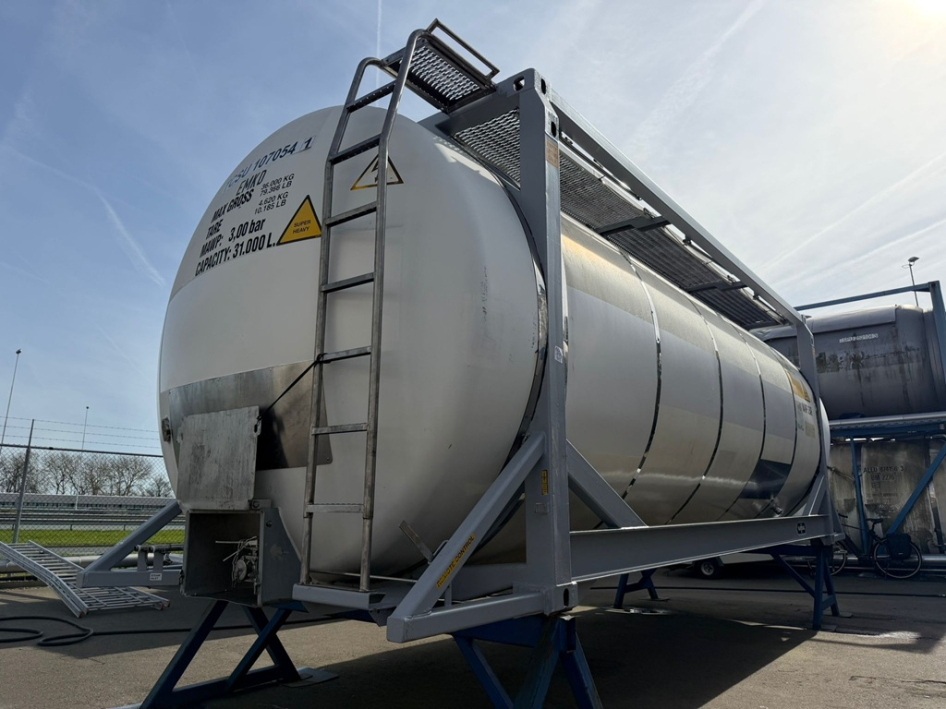
ISO tanks for sale in the UK are widely used for bulk liquid transport and temporary or long-term storage. These tanks are built inside a standard ISO container frame, most commonly in a 20ft format, so they can be handled by container ports, road hauliers, rail terminals and shipping lines without special non-standard equipment. For companies moving chemicals, food-grade liquids, oils, resins, additives or industrial fluids, this makes day-to-day logistics much easier to control.
A typical ISO tank offers a capacity of around 21,000 to 26,000 litres, depending on the tank design, pressure rating, insulation and cargo type. One 24,000-litre ISO tank can replace roughly 120 standard 200-litre drums, which means fewer filling points, less packaging waste and lower handling risk. That is one of the reasons UK businesses prefer ISO tanks over drums or IBCs for repeat liquid movements.
When we assess an ISO tank, we look beyond the price. The tank’s test date, working pressure, stainless steel grade, valve layout, cleaning status, previous cargo history and certification all affect whether it is suitable for your product. A food-grade tank, chemical tank and storage-only tank may look similar from outside, but operationally they are very different.
New and Used ISO Tanks for Sale in the UK
New and used ISO tanks are both available in the UK, and the right choice depends on your cargo, budget, required lead time and how long you plan to use the tank. A new ISO tank gives you a clean service history, factory documentation and the opportunity to specify features such as insulation, steam heating coils, food-grade valves, specialist linings or higher working pressure.
Used ISO tanks are often preferred when buyers need quicker availability and a lower purchase cost. Many used tanks are still perfectly suitable for transport or storage, provided the inspection records, frame condition, internal surface and valves are in good order. A used tank with a valid 5-year test or recent 2.5-year inspection is usually more valuable than a cheaper unit with expired documents.
Before buying a used ISO tank, we always recommend checking the tank number, data plate, CSC plate, last test certificate, internal photos and previous cargo history where available. A low-cost tank can become expensive if it needs pressure testing, valve replacement, cleaning, cladding repair or recertification before use.
Types of ISO Tanks Available in the UK
ISO tanks available in the UK are designed for different cargo types and operating conditions. The most common units are standard liquid ISO tanks, usually built in a 20ft frame with stainless steel barrels. These are used for non-hazardous liquids, oils, additives, industrial fluids and many compatible food or chemical products.
Food-grade ISO tanks are used for edible liquids such as vegetable oils, liquid sugar, wine, spirits, syrups and fruit concentrates. These tanks need clean internal surfaces, suitable seals, hygienic valve arrangements and a cargo history that does not compromise food safety.
Chemical ISO tanks are used for solvents, acids, alkalis, resins, latex, cleaning chemicals and regulated industrial liquids. Some chemicals need lined tanks, higher pressure ratings, specific gasket materials or restricted valve configurations.
You may also see heated ISO tanks, insulated tanks, lined tanks, gas tanks, powder tanks and swap body tanks. The important point is simple: the tank must match the product. Capacity alone is never enough to confirm suitability.
Standard ISO Tank Containers for Sale
Standard ISO tank containers for sale in the UK are usually 20ft units designed for bulk liquid transport and storage. They are built with a cylindrical stainless steel tank mounted inside a rectangular steel frame. That frame allows the tank to be lifted, stacked and transported using standard container equipment at ports, depots and industrial sites.
Most standard liquid ISO tanks hold between 24,000 and 26,000 litres, though lower-capacity units such as 21,000-litre tanks are also common where higher pressure or heavier cargo requirements apply. Many tanks are fitted with top loading access, bottom discharge valves, pressure relief valves, manlids, walkways and protective frames.
A standard ISO tank is suitable for many non-hazardous liquids and compatible industrial products, but it should not be treated as a universal tank. Product density, temperature, viscosity, valve compatibility and cleaning requirements must be checked before loading.
For UK buyers, the practical benefit is flexibility. A standard ISO tank can move by road, rail or sea and can also be used as static storage when site conditions are suitable.
Food Grade ISO Tanks for Sale UK
Food grade ISO tanks for sale in the UK are designed for edible liquid products where hygiene, cargo history and internal cleanliness are critical. These tanks are commonly used for vegetable oils, sunflower oil, rapeseed oil, palm oil derivatives, liquid sugar, glucose syrup, wine, spirits, juice concentrates and food additives.
A food-grade ISO tank is normally built with a stainless steel barrel and product-contact parts that can be cleaned effectively. The internal surface should be smooth, free from heavy pitting and suitable for repeated wash cycles. Seals, gaskets and valves must be compatible with the cargo, because even a small odour or residue issue can cause product rejection.
Previous cargo history matters a great deal. Many food producers will not accept a tank that has carried chemicals or unknown cargoes. Cleaning certificates, last cargo details and internal inspection photos help reduce risk before purchase.
For viscous products such as syrups or oils, heating coils and insulation can make discharge easier, particularly during colder UK months. A tank that cannot discharge properly can delay production and increase handling costs.
Chemical ISO Tanks for Sale UK
Chemical ISO tanks for sale in the UK must be selected with close attention to product compatibility, certification and safety requirements. These tanks are used for solvents, acids, alkalis, resins, latex, detergents, additives, coatings and many other industrial liquids. Some cargoes are non-hazardous, while others fall under dangerous goods regulations and need approved tank equipment.
A chemical ISO tank may require stainless steel construction, specialist lining, specific pressure relief settings, compatible gaskets, bottom discharge restrictions or heating capability. The Safety Data Sheet should always be checked before choosing the tank. Details such as UN number, hazard class, density, flash point, corrosiveness and loading temperature can all affect suitability.
Used chemical ISO tanks need careful inspection. We look at the internal surface, outlet area, valve condition, pressure relief valve, manlid, frame, cladding and test date. Previous cargo history is also important, because residue, odour or corrosion from earlier products may affect future use.
Buying the wrong chemical tank can lead to loading refusal, safety concerns or expensive modification work. Technical matching comes before price.
Stainless Steel ISO Tanks for Sale UK
Stainless steel ISO tanks are popular in the UK because they offer strength, cleanability and good resistance to many food-grade and chemical cargoes. Most liquid ISO tanks use stainless steel barrels, commonly 316L or a similar grade depending on the tank specification and manufacturer. This material is well suited to repeated cleaning, liquid transport and long-term operational use.
Stainless steel does not mean every cargo is automatically suitable. Some aggressive chemicals, chloride-rich products or high-temperature cargoes may require a lined tank or specialist material compatibility check. For food use, stainless steel helps with hygiene, but previous cargo history and cleaning standards still matter.
When buying a stainless steel ISO tank, buyers should review the internal condition carefully. Pitting, staining, dents, weld marks, residue and signs of corrosion can affect suitability. The frame, valves, manlid, pressure relief valve, insulation and cladding should also be inspected.
A well-maintained stainless steel ISO tank can remain useful for many years. That is why condition, documentation and correct product matching are more important than age alone.
ISO Tank Sizes and Specifications
ISO tank sizes and specifications vary depending on cargo type, working pressure, design code and intended use. In the UK, the most common format is the 20ft ISO tank, with external frame dimensions close to 6,058 mm long, 2,438 mm wide and 2,591 mm high. This standard size allows the tank to move through container ports, road networks and rail terminals with normal container handling systems.
Typical capacities range from 21,000 to 26,000 litres. A 21,000-litre tank may be used for higher-pressure or heavier cargoes, while 24,000 to 26,000-litre tanks are common for general liquid products. Capacity should always be checked against product density. A dense liquid may reach maximum payload before the tank is full.
Specifications to review include tare weight, maximum gross weight, working pressure, test pressure, stainless steel grade, valve layout, insulation, heating coils, manlid size, pressure relief valve setting and inspection dates.
The best tank is not always the largest one. It is the unit that fits the cargo, route, discharge method and site conditions without creating compliance or handling problems.
20ft ISO Tanks for Sale UK
20ft ISO tanks are the standard choice for bulk liquid transport and storage in the UK. Their frame size matches the global 20ft container format, so they can be moved on skeletal trailers, lifted by container handling equipment and shipped through major ports. For most buyers searching for ISO tanks, the 20ft unit is the starting point.
A typical 20ft ISO tank holds around 24,000 to 26,000 litres, though some designs offer lower capacities for pressure or cargo-specific reasons. The tank may be insulated, heated, lined, food-grade, chemical-grade or configured for standard liquid service. From the outside, many 20ft tanks look similar, but the technical specification can be very different.
These tanks are often used for oils, food ingredients, solvents, resins, additives, waste liquids and non-hazardous industrial fluids. They can also be placed on site for temporary storage when fixed tanks are not practical.
Before buying a 20ft ISO tank, check access at your site. A full tank can exceed 30 tonnes, depending on the cargo, so the ground, lifting plan and delivery route must be suitable.
How Much Does an ISO Tank Cost in the UK?
The cost of an ISO tank in the UK depends on condition, age, certification, specification, location and whether the tank is new, used, refurbished or storage-grade. A used storage-only tank usually costs less than a cargo-worthy ISO tank with valid inspection documents. A food-grade, heated or chemical-lined tank will normally cost more than a basic standard liquid tank.
A proper price comparison should include more than the purchase figure. Transport, lifting, cleaning, inspection, valve servicing, pressure relief valve checks, repainting, cladding repairs and VAT can all affect the real cost. A cheap tank with expired certification may require several services before it can be used.
New ISO tanks sit at a higher price level because they offer factory documents, clean history and custom specification options. Used tanks can offer strong value when the test dates, internal condition and valve layout match the buyer’s needs.
Before quoting or buying, we always suggest defining the cargo, capacity, delivery postcode and intended use. That gives a much clearer view of total cost.
Factors to Consider Before Buying an ISO Tank
Before buying an ISO tank, start with the product you need to store or transport. The cargo determines the tank type, capacity, pressure rating, valve layout, lining, heating requirement and certification. A tank for edible oil is not assessed in the same way as a tank for corrosive chemicals or waste liquid.
Product density is one of the most practical checks. A 26,000-litre tank may not be able to carry 26,000 litres of a heavy liquid if the maximum payload is reached earlier. Viscosity matters too. Thick products may need steam heating coils or insulation to discharge properly.
Certification should be reviewed before purchase. Check the CSC plate, data plate, last test date, next test due date and inspection documents. If the tank will travel loaded, expired certification can create delays.
Site conditions also matter. You need safe access for delivery, suitable lifting equipment, level ground, hose connections and room for discharge. A good ISO tank purchase should fit both the cargo and the site, not just the budget.
ISO Tank Certification and Inspection Requirements
ISO tank certification and inspection requirements are essential for safe and legal use, especially when the tank is used for road, rail or sea transport. A tank may look ready for service, but the documents and plate markings must confirm its status.
Many ISO tanks follow a periodic inspection cycle that includes a 5-year test and a 2.5-year intermediate inspection, depending on tank type and regulatory requirements. These inspections may include internal examination, external examination, pressure testing, leak testing, valve checks and frame inspection.
Important items to check include the CSC plate, data plate, periodic test certificate, working pressure, test pressure, tank number, approval markings and pressure relief valve records. For hazardous cargoes, the tank must also match dangerous goods rules and product-specific requirements.
Static storage tanks still need regular checks, even if they are not travelling loaded. Valves, gaskets, manlids, corrosion points, cladding, supports and spill control arrangements should be monitored.
Good inspection records protect the buyer, haulier, loading site and end customer. Missing paperwork can stop an otherwise usable tank from entering service.
ISO Tank Delivery and Transport Across the UK
ISO tank delivery across the UK can be arranged to ports, depots, factories, farms, chemical sites, food production facilities, storage yards and project locations. Empty 20ft ISO tanks are commonly moved on skeletal trailers, while loaded tanks require additional checks around cargo weight, route, regulations and site safety.
Delivery cost depends on distance, vehicle availability, lifting needs, waiting time and access conditions. A tank located near Felixstowe, Southampton, London Gateway, Tilbury, Liverpool, Hull, Immingham or Teesport may be quicker and cheaper to deliver than a unit stored far from your site.
The receiving location must be ready before the tank arrives. If you do not have container lifting equipment, you may need a HIAB vehicle or mobile crane. Ground conditions, overhead cables, narrow entrances, turning space and placement direction should be checked in advance.
For loaded chemical tanks, ADR requirements may apply. For food-grade tanks, seal integrity and hygiene controls may be needed. Good delivery planning prevents failed drops, extra haulage charges and unnecessary delays.
Where to Buy ISO Tanks in the UK
ISO tanks in the UK can be bought from specialist tank container suppliers, container traders, leasing companies, refurbishment yards and international manufacturers with UK or European stock. The right source depends on whether you need a new tank, used tank, food-grade unit, chemical tank, stainless steel tank, heated tank or storage-grade option.
Specialist suppliers are usually the best route when cargo suitability matters. A good supplier will ask about your product, density, temperature, certification needs, delivery location and discharge method before recommending a tank. That level of detail helps avoid buying equipment that cannot be used safely.
General container traders may also offer ISO tanks, though buyers should check whether the seller understands tank certification, pressure ratings and cargo compatibility. Leasing companies sometimes sell older fleet tanks, which may come with clearer maintenance history.
Before buying, request tank number, photos, data plate, CSC plate, capacity, tare weight, test date, valve layout and internal condition details. If a tank is described as cargo-worthy or food-grade, the paperwork should support the claim. Clear information is a good sign.
Frequently Asked Questions About ISO Tanks for Sale in the UK
Buyers searching for ISO tanks for sale in the UK usually ask about price, size, condition, certification, delivery and product suitability. These are the right questions to ask because ISO tanks are technical assets, not ordinary storage containers. A tank’s value depends on what it can legally and safely carry.
Most ISO tanks used in the UK are 20ft units with capacities around 21,000 to 26,000 litres. They are commonly used for food-grade liquids, chemicals, oils, resins, solvents, industrial fluids and temporary storage. Some are built for general liquid service, while others are designed for more demanding cargoes with heating, insulation, lining or specialist valves.
Used ISO tanks are available, but buyers should check test dates, plate details, previous cargo history and physical condition before purchase. Certification matters when the tank will move loaded by road, rail or sea. Delivery is usually possible across the UK, provided the site has suitable access and lifting arrangements.
The answers below cover the questions we hear most often from buyers comparing ISO tanks in the UK market.
What is an ISO tank used for?
An ISO tank is used for bulk liquid transport and storage. In the UK, ISO tanks are commonly used by food producers, chemical companies, logistics operators, manufacturers, waste processors, agricultural businesses and industrial sites that need to move or hold large volumes of liquid safely.
A standard 20ft ISO tank usually carries around 21,000 to 26,000 litres, depending on the model and cargo. That makes it much more efficient than handling hundreds of drums or multiple IBCs. For example, a 24,000-litre ISO tank can replace around 120 x 200-litre drums.
Common cargoes include edible oils, liquid sugar, wine, spirits, fruit concentrates, solvents, resins, acids, alkalis, additives, coatings and industrial fluids. Some ISO tanks are insulated or fitted with steam heating coils for products that thicken in cold weather.
ISO tanks are also used as temporary storage on sites where fixed tanks are not available. The tank still needs safe placement, suitable access, spill control and correct fittings for the product being stored.
How much does an ISO tank cost in the UK?
The cost of an ISO tank in the UK varies according to age, condition, certification, capacity, specification and location. A used storage-grade ISO tank will usually be cheaper than a cargo-worthy tank with valid test documents. Food-grade, chemical-grade, lined, heated or refurbished tanks normally cost more because they require stricter condition and specification checks.
Buyers should look at the full delivered cost, not only the tank price. Cleaning, inspection, valve servicing, pressure relief valve checks, transport, lifting, repainting and VAT can all change the final budget. A lower-priced tank may not be good value if it needs work before it can be loaded.
New ISO tanks cost more than used units but offer clean history, factory certificates and specification control. Used tanks can be a smart option when documents, internal condition and cargo compatibility are clear.
For an accurate price, the supplier needs to know the cargo, capacity requirement, location, intended use and whether the tank must be transport-certified or storage-only.
Can I buy a used ISO tank in the UK?
Yes, used ISO tanks can be bought in the UK through specialist suppliers, leasing fleet sales, container traders, depots and refurbishment companies. Used tanks are popular because they are often available faster than new units and can reduce upfront cost.
The main point is to check what grade of used tank you are buying. A cargo-worthy used ISO tank should have valid inspection status and be suitable for transport. A storage-grade tank may be useful for static storage but not approved for loaded movement. Food-grade and chemical-grade used tanks need closer checks around cargo history and internal condition.
Before buying, request the tank number, data plate, CSC plate, test certificate, external photos, internal photos where available and valve details. If the tank has expired tests, damaged valves or unknown cargo history, the real cost may increase.
A properly inspected used ISO tank can be a reliable asset. A poorly checked one can create repair costs, loading delays and product suitability problems.
What sizes do ISO tanks come in?
ISO tanks come in different sizes and capacities, but the most common option in the UK is the 20ft ISO tank. Its frame is designed to match standard container handling systems, with dimensions close to 6,058 mm long, 2,438 mm wide and 2,591 mm high.
Common liquid ISO tank capacities range from 21,000 to 26,000 litres. Lower-capacity tanks may be used for heavier cargoes or higher-pressure applications. Higher-capacity tanks are useful for lighter liquids where volume efficiency is important.
Capacity should always be checked against payload. A tank may physically hold 26,000 litres, but a dense liquid can reach the maximum gross weight before the tank is full. This is why product density is important when choosing a tank.
There are also gas tanks, powder tanks and swap body tanks for more specialised uses. For most liquid cargo buyers in the UK, a 20ft stainless steel ISO tank is the standard starting point.
Are ISO tanks suitable for chemicals and food products?
ISO tanks can be suitable for both chemicals and food products, but the tank must be selected for the specific cargo. A food-grade ISO tank and a chemical ISO tank may look similar from outside, yet the required checks are different.
Food-grade ISO tanks are used for edible liquids such as vegetable oils, liquid sugar, wine, spirits, syrups and juice concentrates. These tanks need clean stainless steel interiors, food-compatible seals and acceptable previous cargo history. Many food customers will not accept tanks with unknown or chemical cargo history.
Chemical ISO tanks are used for solvents, acids, alkalis, resins, additives and other industrial liquids. Suitability depends on the Safety Data Sheet, UN number, hazard class, pressure requirement, lining, gasket material and stainless steel compatibility.
Cleaning alone does not make every tank suitable for every product. Cargo history, valve condition, seal material and certification all matter. The safest approach is to match the tank to the product before purchase or loading.
Do ISO tanks need inspection or certification?
Yes, ISO tanks need inspection and certification when used for transport, and they should be checked regularly when used for storage. A tank container is a pressure-rated unit, so test dates, plate markings, valve condition and documents matter.
Many ISO tanks follow a 5-year periodic test and 2.5-year intermediate inspection cycle, depending on tank type and applicable rules. These inspections may include internal checks, external checks, pressure testing, leak testing, valve inspection and frame review.
Key documents and markings include the CSC plate, data plate, periodic test certificate, tank number, working pressure, test pressure and approval information. For dangerous goods, the tank must meet the required transport rules for that cargo.
A tank with expired certification may be refused by hauliers, terminals, ports or loading sites. For static storage, certification rules may differ, but the tank still needs to be safe, leak-tight and suitable for the product. Good records protect both safety and asset value.
Can ISO tanks be delivered anywhere in the UK?
ISO tanks can be delivered to most UK locations, provided the site is suitable for heavy vehicle access and safe unloading. Delivery is common to factories, farms, depots, ports, storage yards, chemical plants, food production sites and construction projects.
An empty 20ft ISO tank is usually transported on a skeletal trailer. If the delivery site has container lifting equipment, unloading is straightforward. If not, a HIAB vehicle or mobile crane may be required. This should be arranged before delivery day, not after the vehicle arrives.
Site access is often the main challenge. Narrow entrances, soft ground, low bridges, overhead cables, tight turning areas and limited unloading space can all cause problems. A full tank can weigh over 30 tonnes, depending on the cargo, so the ground must be suitable.
Loaded tank deliveries need extra planning around product weight, ADR requirements if hazardous, documentation and discharge arrangements. With clear site details, photos and lifting plans, ISO tanks can be delivered safely across the UK.